

The short answer is yes, it is absolutely okay to quit a job after 3 months. You are not obligated to stay somewhere that does not serve your career, your health, or your livelihood.
While the old rule of “stay at least one year” still gets repeated, the data and the workplace reality in 2025 tell a more nuanced story. This article breaks down exactly what you need to know before you hand in your resignation.
How Common Is It to Leave a Job Within 3 Months?
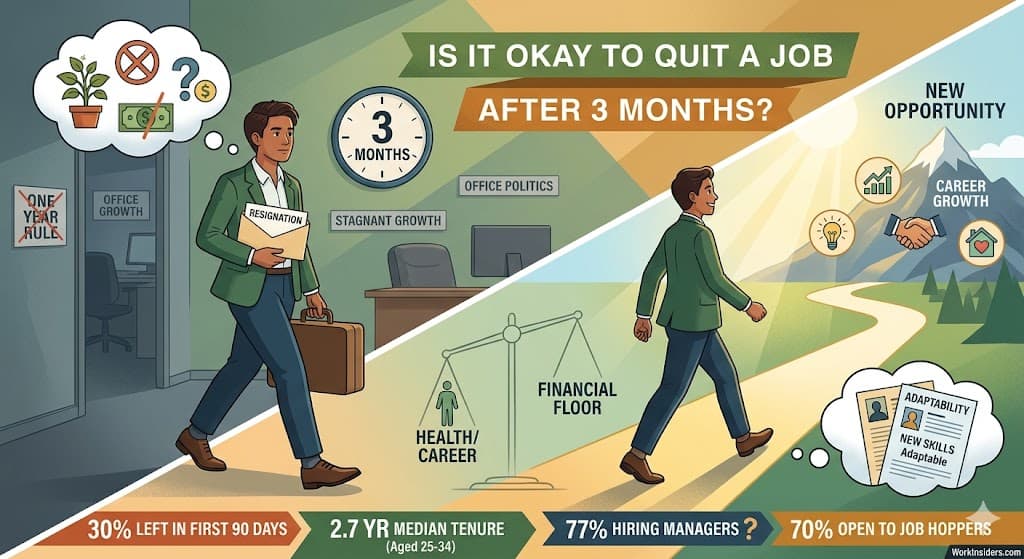
You are far from alone if you are thinking about quitting early. According to a recent Employ survey, 30 percent of employees have left a job within their first 90 days. Career.io The majority reported that the day-to-day role was not what they expected, which is a deeply valid reason to move on.
Over 22% of workers aged 20 and older spent a year or less at their jobs in 2022, the highest percentage with a tenure that short since 2006, according to data from the Employee Benefit Research Institute. Executive Recruiters Short tenures are becoming the norm, not the exception.
The “one year minimum” rule made sense in a labor market where workers expected to build careers at single companies and pensions rewarded loyalty. That market no longer exists for most people. The median job tenure in 2024 was recorded as the lowest figure seen since 2002, with the typical active job seeker having been in their current role for approximately two years and three months. IndexBox
What Are the Valid Reasons to Quit After 3 Months?
The Job Was Misrepresented During Hiring
This is the most common reason workers leave early. You accepted an offer based on what was described in interviews, and what you found on day one was something different. That is not on you. You might get to work on the first day and quickly realize the employer did not fully explain the scope of the role during the hiring process, or you might learn the company has a toxic culture with a history of stress and burnout. Career.io
If the job was misrepresented, leaving is not impulsive. It is a rational response to having been misled.
The Culture Is Toxic or Unsafe
Toxic workplaces cause real harm. Chronic stress, public humiliation by managers, exclusion, or ethical violations are not things you are obligated to endure to check a resume box. Staying in a harmful environment in the name of “not being a quitter” is not professionalism, it is self-sabotage.
You Got a Significantly Better Offer
According to a 2024 LinkedIn study, employees who switch jobs can see salary increases of 10 to 20 percent, far outpacing the typical 3 to 5 percent annual raise. JobAdvisor If a better opportunity lands in your lap three months in, taking it is not disloyalty. It is strategic career management.
The Role Has No Growth Path
Three months is long enough to recognize whether advancement is realistically available to you. If the organization is stagnant, leadership is inaccessible, and there is no development investment, waiting out the year will not change any of that.
Will Quitting After 3 Months Hurt Your Career?
What Employers Actually Think
The honest answer is: it depends. A survey conducted by Robert Half found that 77% of hiring managers named job hopping as a top concern when evaluating a candidate’s resume. The Seattle Times That number sounds alarming, but context matters significantly.
Career experts often define job hopping as staying in roles for less than two years, and a management professor notes that if an individual is systematically in jobs for less than two to three years, potential employers may become concerned. IndexBox One three-month stint is not a pattern. It becomes a concern when every role on your resume shows a short tenure.
A 2023 FlexJobs survey suggests that 70% of hiring managers are more open to job hoppers if candidates can demonstrate clear value. JobAdvisor How you explain the exit matters more than the exit itself.
Is the Job-Hopping Stigma Fading?
Yes, meaningfully so. Workers aged 25 to 34 in 2024 had a median tenure of 2.7 years, only slightly lower than Baby Boomers at the same age in 1983, and researchers note that economic conditions, rather than generational attitudes, drive worker turnover. National Institute on Retirement Security
A gap in your resume or an average job tenure of 1.5 years or less would have been a big red flag for employers in the past, but many employers now look beyond the job hopper stigma and recognize the benefits that job hoppers can bring, such as adaptability, innovation, and new skills. Morgan McKinley
Younger hiring managers are also changing the equation. For hiring managers under 30, the proportion who would be less likely to hire a job hopper falls to 35%, with a rising proportion indicating it would have no impact or even a positive impact on their decision. Hays
Should I Quit Without Another Job Lined Up?
This is a deeply personal financial question, not a career purity test. The practical answer is that having another offer lined up is always the safer path, but it is not always possible.
If you are in a situation that is actively harming your mental health, your finances are stable enough to weather a gap, and you have a plan for your search, leaving without an offer can be the right call. The BLS quit data consistently shows that voluntary quits spike in strong labor markets because workers know they can land something else quickly.
What you should avoid is quitting impulsively because of one bad week. Three months is enough time to distinguish a rough adjustment period from a genuinely bad situation, but be honest with yourself about which one you are actually facing.
How Do You Explain Leaving After 3 Months in an Interview?
Keep It Honest and Forward-Focused
This is the make-or-break piece. Hiring managers do not automatically disqualify early exits. They disqualify candidates who cannot explain them clearly, or who use the explanation as a platform to criticize a former employer.
A strong explanation does three things: it acknowledges the short tenure directly, provides a credible reason without badmouthing, and pivots to what you are looking for now. For example: “The scope of the role turned out to be significantly different from what was described during the interview process. Once I had a clear picture of the fit, I made the decision to pursue opportunities better aligned with where I am trying to grow.”
Just be honest with your employer about why you are leaving, as lying could cause issues later in your career search if you use them as a reference. Zippia
Do You Even Need to List It?
If the role lasted less than 90 days and you secured another position without a visible gap, many career coaches argue you do not need to list it at all. If you land a job within the next 30 to 60 days after leaving, you may not need to list the short stint on your resume, and most hiring managers are not overly concerned about gaps under three to six months. LinkedIn
Use your judgment. If the role was relevant or if the gap would be otherwise unexplained, include it with a brief, professional framing.
What Should You Do Before You Quit?
Have the Conversation First
Before submitting your resignation, consider whether the situation is fixable. A direct conversation with your manager may surface solutions you had not considered, such as a role adjustment, a team transfer, or a revised set of responsibilities. You have nothing to lose by having the conversation, and you may either solve the problem or confirm that leaving is the right move.
Provide your current company the chance to negotiate for your retention because there may be adjustments they can make related to total rewards, flexibility, or job title. Indeed
Check Your Financial Floor
Before you quit, know your numbers. How many months of expenses do you have saved? What happens to your health insurance? When does any equity or employer 401(k) matching vest? Three months is almost always too early for any meaningful vesting to have occurred, but confirm this before you leave.
Give Proper Notice
While two weeks is the standard notice most employees give when they leave a position, you may offer to continue working for a longer period of time depending on your career plans. Indeed Leaving professionally protects your reference and your reputation, even if you never plan to work in that industry again.
Quick Q&A: Common Questions About Quitting After 3 Months
Q: Is it unprofessional to quit after 3 months? No. Leaving a job that is not a good fit is a professional decision. What is unprofessional is leaving without notice, badmouthing your employer, or abandoning critical work without a handoff plan.
Q: Will a 3-month job ruin my resume? One short stint will not ruin your resume. A pattern of multiple short stints across every role over several years can raise questions. A single early exit, explained well, is survivable and often entirely forgettable to hiring managers.
Q: Can I collect unemployment if I quit after 3 months? Generally, no. Most states require that separation be involuntary to qualify for unemployment benefits. If you resign voluntarily, you typically do not qualify unless you can demonstrate the work environment met a legal standard of “good cause” for leaving, which varies by state. Check your state’s DOL guidelines for specifics.
Q: How long should I realistically stay to make the role worth having? If the situation is genuinely unfixable, no amount of time changes the calculus. If you are on the fence, give it a defined window, perhaps 30 more days, with a specific benchmark: if X has not changed by then, you leave. That approach avoids both impulsive quitting and indefinite suffering.
The Bottom Line
Quitting a job after three months is okay. It is legal, increasingly common, and in many cases the smartest career move you can make. The stigma attached to it is fading as labor markets evolve and hiring managers reckon with the reality that employees are rational actors responding to real conditions.
What matters is not how long you stayed, but whether you left professionally, whether you can explain the decision clearly, and whether you are moving toward something better rather than just running from something worse. Know your reason, protect your finances, give proper notice, and move on with your head up.
You do not owe any employer your silence about a bad experience, your mental health, or years of your career that could be spent somewhere better.
Sources: Employ survey via Career.io | BLS job tenure data | NIRS research on job hopping | Robert Half hiring manager survey | LinkedIn salary data via jobadvisor.link
Free newsletter
Get the Work Insiders weekly
One email a week: the recruiting and HR tech news that mattered, the tools we just added to the directory, and one practical guide. No spam, and you can unsubscribe in one click.