

The job description is not a contract. It is a wish list. And wish lists are negotiable. Here is how to walk into an interview with a skills gap and walk out as the top candidate.
The truth about job requirements that most candidates do not know
Most job postings are not a checklist. They are a portrait of a fantasy candidate that HR assembled by asking every stakeholder what they would want in a perfect hire and then listing all of it. The result is a document that would make Superman feel underqualified. As Ask a Manager puts it, requirements are a composite of someone’s idea of an ideal candidate, not a legal threshold you must clear before the door opens.
A former recruiter with two decades of experience explains it plainly: the first question she always asked a hiring manager in their intake session was, “What on this list are must-haves and what are nice-to-haves?” The hiring manager’s answer almost never matched what was written in the public posting. Priorities shift. The person who left may have done the job differently than it was described. And sometimes the requirements were copy-pasted from a template that does not reflect the actual role at all.
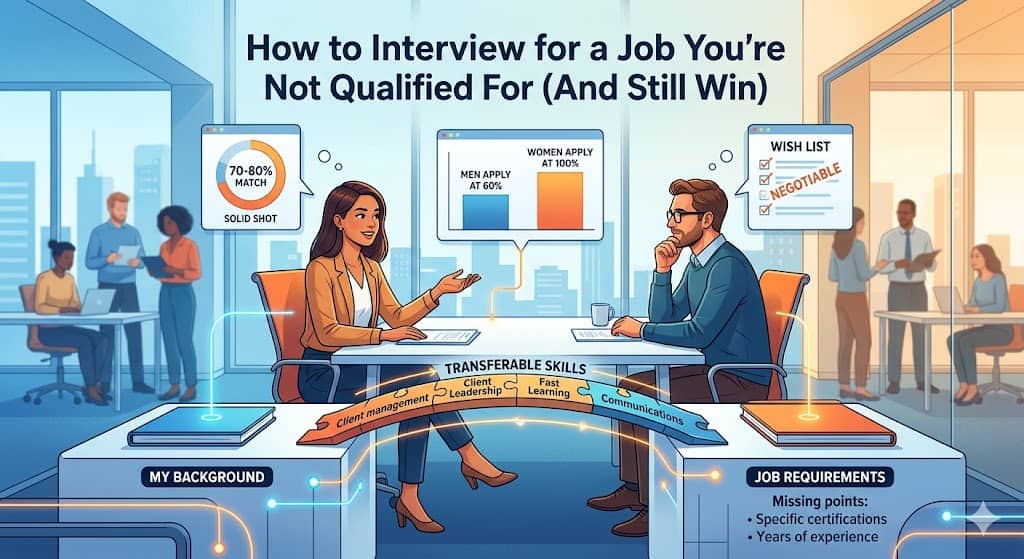
- 60% of men apply when meeting only 60% of qualifications
- 70–80% match rate gives you a solid shot at an interview, per recruiting experts
- 100% match often signals you are overqualified and will get bored
There is also a well-documented gender gap in how people apply. Research highlighted in Vice found that men apply when they meet roughly 60 percent of qualifications, while women tend to hold back until they feel they meet all of them.
The barrier in most cases is not ability. It is the false assumption that every listed requirement is a hard requirement. It is not.
Should you even apply if you’re underqualified?
Yes, within reason. The honest calculus is this: if you can do 70 to 80 percent of what the job requires and you can make a compelling case for the rest, you belong in that conversation. If the gap is enormous, applying wastes your time and theirs. The key question is not whether you are missing qualifications. It is whether you would be out of your depth in a way that would genuinely compromise your performance and ultimately your career.
Is it worth applying for a job that requires 5 years of experience when I only have 2?
Probably yes, especially if those 2 years involved work that punches above its weight. Experience requirements are often aspirational. A candidate with 2 years of strong, relevant output can outperform someone with 5 years of going through the motions. Apply, but put serious effort into your cover letter and be ready to connect the dots in the interview.
One hiring expert puts it bluntly: if you can do 60 percent of what is asked in the job announcement, apply for it, always. Companies are looking for the perfect candidate, but it does not exist. The requirements change during the hiring process, and the person who ultimately gets hired may look very different from what was originally posted.
What to do before the interview when you know you have a gap
The preparation phase is where most underqualified candidates win or lose before they ever sit down. Getting to the interview is the hiring manager already signaling that something in your background caught their eye. USC Senior Career Director Lori Shreve Blake makes this point clearly: any time an employer invites you for an interview, they believe you have the skills, experience, and ability to do the job. The interview invitation is itself a vote of confidence.
- Print the job description and mark every requirement you do not fully meet. Be honest with yourself about which gaps are real and which are just confidence issues.
- For each gap, identify something from your history that is adjacent, transferable, or demonstrates a fast learning curve in a related area.
- Research the company beyond the website. Find people in the role on LinkedIn. Read their earnings calls, press releases, or recent news to understand the actual problems this hire is meant to solve.
- Prepare a 60-second narrative that explains why you applied despite knowing you are not a perfect match on paper. Own the gap before they ask about it.
- Pull three to five specific stories from your past that show high performance, fast learning, or initiative in unfamiliar territory.
The one question to answer before walking inWhy would hiring me despite a gap be a better decision than waiting for someone who checks every box? If you cannot answer that question confidently, keep preparing. If you can, you are ready.
How do you talk about your skills gap without killing your chances?
Acknowledge it, do not apologize for it, and then immediately redirect to what you bring. The worst thing you can do in an interview is pretend the gap does not exist. The second worst thing is to lead with it as a liability. The goal is to name it briefly, contextualize it honestly, and pivot to your strengths in the same breath.
A clean framework: “I know my background in X is lighter than what you outlined. What I bring instead is Y and Z, which I believe addresses the same underlying need. And I want to be transparent that closing the gap in X is something I am actively working on, specifically through [course, project, self-study].” This structure shows self-awareness, substance, and initiative all at once.
What if the interviewer asks directly why they should hire me when I don’t meet all the requirements?
This is the best question you can get. It means they are genuinely considering you. Answer it in three parts: what you do bring that is directly relevant, what you have done in the past when you faced a steep learning curve and came out stronger, and what specific steps you are taking right now to close the gap. Concrete examples beat vague assurances every time.
How to use transferable skills to close the distance
Transferable skills are the most underused tool in an underqualified candidate’s kit. The mistake is assuming that because you have not held the exact title, you have not done the work. A sales background prepares you for client management. Years of freelance writing prepares you for content strategy. Financial analysis experience translates directly into operations roles. The job is to make those connections explicit so the interviewer does not have to figure it out themselves.
Indeed points out that candidates who arrive through different routes often have diverse experience that internally promoted candidates simply do not. Someone who took an unconventional path to a role brings fresh perspective, cross-functional fluency, and skills that others in the department have never developed. That is not a weakness dressed up as a strength. It is an actual competitive advantage if you frame it that way.
“People who have worked their way up to that position through similar roles may not have the diverse experience you have from working in other roles. Emphasizing those unique skills can show prospective employers what you bring.”Indeed Career Advice
How to map your transferable skills before the interview
Go through every required qualification in the job posting. For each one you cannot match directly, write down the closest experience you have from any part of your professional or personal history, including volunteer work, side projects, or education.
Then write one sentence explaining how that experience prepares you to handle that requirement. This exercise gives you a ready answer for almost every gap before the interviewer brings it up.
Should you do a pre-interview project to compensate for missing experience?
For the right role, yes, and it can be a decisive differentiator. TopResume calls this an extra-credit move that has the potential to get the hiring manager to look past missing qualifications entirely. The idea is simple: prove that you understand the challenges of the position and can already begin solving them, before you are ever hired.
- A product positioning analysis for a marketing or strategy role
- A redesigned landing page or UX audit for a product or design position
- A sample content calendar or editorial plan for a content or communications role
- A short competitive landscape report for a business development or analyst role
- A proposed improvement to a visible process or product the company actually uses
Do not send this unsolicited before the first interview. Bring it as a physical or digital leave-behind, mention it naturally when discussing how you would approach the role, and offer to walk through it if they are interested. The signal it sends is not just competence. It is the kind of initiative that hiring managers remember long after the interview ends.
Is doing unpaid work for a company before they hire you a bad idea?
There is a real debate here. A brief, self-initiated project that demonstrates your thinking is different from a company asking you to complete hours of work as part of a lengthy interview process. The former shows initiative and costs you a few hours. Keep it scoped, keep it focused on a single insight or problem, and think of it as a portfolio piece you own regardless of the outcome.
How to answer the hard questions without lying
Honesty is not just the ethical choice here. It is the strategic one. InterviewFocus advises that the best interview tip for an underqualified candidate is to be upfront about experience and qualifications from the start.
Hiring managers who discover after the fact that a candidate misrepresented their background will not just reject the offer. They will remember it. The career damage from being caught in a resume exaggeration far outweighs the short-term gain.
What you can do honestly is provide context. “I have not managed a team of ten, but I have led cross-functional project groups of five with full accountability for delivery.” That is not a lie. That is accurate framing. There is a meaningful difference between misrepresenting your background and presenting it in its best, most relevant light.
What if you get asked about a hard technical skill you genuinely do not have?
Name it plainly, then demonstrate your learning velocity. Something like: “I have not worked extensively with that platform, but I did come up to speed on a comparable system in about three weeks at my last job and was training others within two months.
I have already started exploring the documentation and have set aside time this week to work through the fundamentals.” Hiring managers are not always looking for someone who already knows everything. They are looking for someone who will not stall when they hit something unfamiliar.
Why soft skills can outweigh missing credentials
Hiring is a more emotional process than most candidates realize. The person deciding whether to bring you on board is a human being looking for someone they trust, like, and believe will succeed on their team. Hard skills can be learned. Cultural fit, communication quality, energy, and the ability to handle ambiguity are harder to train for and easier to evaluate in a conversation.
Clarity on Fire describes it directly: you would be amazed how far authentic enthusiasm can take you in the interview process. Candidates who walk in with genuine passion for the company, a real understanding of the problems the team is working on, and a track record of being trusted and relied upon by people around them can absolutely win out over someone with a more polished resume who gives robotic, prepared answers.
The real interviewThe skills test is only half the evaluation. The other half is: does this person have the judgment, the drive, and the temperament to figure out what they do not yet know? That is something a credential cannot prove and only the interview can reveal.
What to do after the interview to stay ahead
Send a thank-you note within 24 hours and use it strategically. This is not a formality. It is a second chance to address anything that did not land in the room, reinforce a key point about your transferable background, and signal follow-through. Keep it short, specific, and personal. Reference something specific from the conversation that a generic note would not include.
If you promised to send anything during the interview, whether that is a link, a portfolio piece, or the pre-interview project you mentioned, send it with the follow-up note. Every commitment you keep before being hired tells them something about how you will behave after.
What if I don’t get the job? Was interviewing even worth it?
Often, yes. One real story from The Financial Diet shows a candidate who did not get the stretch role she interviewed for but was offered an acting promotion a few months later because her managers remembered how well she had performed in the process. The interview that does not convert into an offer can still convert into something valuable, including referrals, a different role, or a relationship that pays off later.
When you genuinely should not apply
There are real limits here. If a role requires a professional license, a regulated certification, or a degree that is a legal prerequisite for the work, no amount of enthusiasm closes that gap. A company cannot hire you as a licensed engineer, a practicing attorney, or a clinical social worker if you do not hold the required credential. These are not wish-list items.
Beyond legal requirements, use honest self-assessment. If you would need extensive training to do the job at a basic functional level and the company is lean with no bandwidth to support that ramp-up time, the hire will fail and it will follow you.
Former recruiter advice puts the honest threshold at meeting 70 to 80 percent of requirements to have a solid shot. Below that, the risk goes up sharply for both sides.
The goal is not to talk yourself into every room. The goal is to stop talking yourself out of rooms you belong in. Most people who do not apply for stretch roles are not being realistic. They are letting a self-limiting assumption do the deciding for them. Job descriptions do not get to decide what you are worth. You do, and then you show up and prove it.
The bottom line:
If you got the interview, someone already believes you might be worth it. Your job is not to prove you are perfect. Your job is to prove you are the most motivated, self-aware, and capable candidate in the room. That is a winnable argument even when you are missing a few lines on your resume.
Free newsletter
Get the Work Insiders weekly
One email a week: the recruiting and HR tech news that mattered, the tools we just added to the directory, and one practical guide. No spam, and you can unsubscribe in one click.