

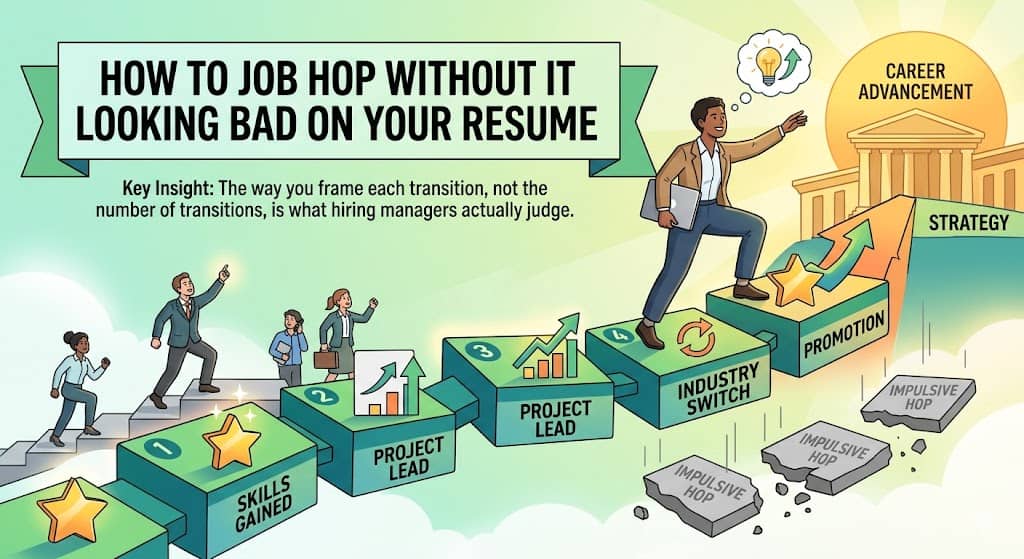
Frequent job changes no longer have to be a career liability. Here is exactly how to frame them so hiring managers see a strategist, not a flight risk.
Key Takeaways
- Median U.S. job tenure hit a 22-year low in 2024 at just 3.9 years, meaning job hopping is structurally normal.
- Only about half of hiring managers now flag frequent job changes as an automatic red flag.
- The way you frame each transition, not the number of transitions, is what hiring managers actually judge.
- A skills-forward or hybrid resume format reduces attention on short tenures and puts results front and center.
- Every job hop needs a purposeful narrative. “I left for growth” is not enough. Specific is credible.
- Your cover letter and LinkedIn headline do heavy lifting before a recruiter ever reads a single date.
Job hopping used to be a career death sentence. Show too many employers on your resume and you would get filtered out before a human ever read your name. That world is gone. BLS data now shows median U.S. employee tenure hit 3.9 years in January 2024, the lowest figure recorded since 2002. The workforce is moving faster than it ever has, and most recruiters know it.
The real question is not whether you have moved around. The real question is whether your moves look intentional or impulsive. This guide is built around that distinction. Every tactic below is designed to help you present a multi-employer history as evidence of ambition, adaptability, and accumulated skill rather than instability.
Is Job Hopping Actually Still a Red Flag in 2025 and 2026?
The short answer is: sometimes, for some employers, yes. But the landscape has shifted dramatically. Research found that only about half of hiring managers now see frequent job hopping as a red flag at all. That number was much higher a decade ago. The stigma is fading, but it has not fully disappeared, which is exactly why framing still matters.
44% of CFOs say they are less likely to hire a candidate with a history of job hopping, according to a recent survey. That means 56% either do not care or consider it irrelevant if the candidate is the right fit.
Context is everything. Career experts note that employers care less about how often you changed jobs and more about why. A pattern of two-year stints where you were visibly promoted each time tells a completely different story than a pattern of eight-month stints with no clear trajectory.
Q: How many jobs in 10 years is considered job hopping?
According to CFOs surveyed recently, six jobs in ten years qualifies as job hopping in their eyes. Most employees put the threshold at five. In practice, the concern is less about the count and more about whether each move had a clear, articulable reason behind it.
Q: Is it okay to leave a job after 1 year?
Yes, one short tenure is rarely a concern on its own. What raises recruiter eyebrows is a consistent pattern of leaving every 6 to 12 months across three or more consecutive roles with no explanation. A single short stint surrounded by longer tenures reads as a circumstance, not a personality trait.
How Do You Format a Resume When You Have a Lot of Short Jobs?
The standard chronological resume was designed for people who spent five or more years in each role. If that is not your history, a standard chronological format works against you by putting the dates front and center before a recruiter has any reason to care about you yet. You have options.
Use a Hybrid Resume Format
A hybrid or combination resume leads with a skills summary and key achievements section before the work history timeline. This means a recruiter reads your actual results first and the list of employers second. By the time they reach your tenure dates, they already have a reason to want to continue. TopResume recommends this approach specifically for job hoppers: showcase skills, achievements, and abilities at the top, then let the work history confirm rather than introduce.
Group Related Short-Term Roles Under One Header
If you held several contract, freelance, or project-based positions in the same period, consider grouping them under a single block labeled something like “Independent Consulting, 2022 to 2024” with the individual clients or projects listed underneath.
This is honest, clean, and prevents a recruiter from mentally counting five separate employer logos and losing the plot of your career story.
Lead With Impact Bullets, Not Duties
The fastest way to make a short tenure look significant is to replace job description language with quantified results. “Managed social media accounts” is forgettable. “Grew organic Instagram reach by 140% in eight months, outperforming the previous year’s full-year benchmark” is not.
Numbers give tenure context. A short stay that produced outsized results reads very differently than a short stay that produced nothing memorable.
A note on omitting months: Some career blogs advise listing only years instead of month/year on your resume to hide short tenures. Recruiters know this technique and will raise it in interviews. It can also create problems when background checks verify employment dates. Lead with your achievements instead. Transparency paired with strong results is always more durable than obscuring the timeline.
What Is the Best Way to Explain Job Hopping on a Resume?
You explain it before anyone has to ask. The best job hoppers are proactive storytellers, not defensive explainers. Every transition on your resume should have a clear forward motion attached to it. The narrative should read: I was here, I achieved this, I moved toward something more specific or more challenging.
Write a Tight Professional Summary at the Top
Your professional summary, that two or three sentence block at the very top of the page, is prime real estate. Use it to characterize your varied background as a deliberate asset. Something like: “Growth-focused operations leader with experience scaling teams across three high-growth startups. Brings cross-industry perspective in logistics, SaaS, and e-commerce with a track record of reducing onboarding cycle time by an average of 30% per engagement.” That framing takes a multi-employer background and makes it the point, not the problem.
Use the Cover Letter to Control the Narrative Early
Your cover letter is the first place you can address your work history on your own terms, before a recruiter asks about it. Jobcase advises starting to prepare your exit statement the moment you leave a job, while the reasons are still fresh.
That preparation feeds directly into a strong cover letter paragraph that briefly explains the logic of your moves and pivots quickly to why this specific role is a purposeful next step, not another impulsive hop.
“Employers care less about how often you changed jobs and more about why.”Masiello Employment Services, 2026
How Do You Answer “Why Have You Changed Jobs So Often?” in an Interview?
This question is coming. Prepare for it the same way you would prepare for a behavioral question: with a specific, structured answer that demonstrates self-awareness without sounding rehearsed or defensive.
The Three-Part Answer Framework
The most effective response to this question has three components. First, briefly acknowledge the pattern without apologizing for it. Second, give the specific reason behind each transition, emphasizing growth, opportunity, or circumstances beyond your control. Third, connect everything to why you are sitting in that chair today.
An example: “You will notice I have moved a few times in the last four years. Each move was deliberate. My first role gave me a strong foundation in performance marketing, but when the company was acquired and my team was eliminated, I joined a startup where I could own the function end to end. After 18 months there, I had built the system from scratch and was ready for a larger scale environment, which led me to my last role. Each step built directly on the last.
What I am looking for now is a place where I can stay and go deep, which is why this particular role caught my attention.”
Never Speak Negatively About a Former Employer
This is the fastest way to lose the room. Even if a former manager was genuinely difficult or a company was genuinely dysfunctional, frame your reason for leaving around what you were moving toward, not what you were escaping.
Career coaches consistently flag that criticizing former employers signals emotional immaturity to hiring managers and raises the question of what you might say about their company someday.
Q: Should you address job hopping in a cover letter or wait for the interview?
Address it in the cover letter if your resume shows a pattern that will be immediately visible. A brief, confident sentence explaining the arc of your moves shows self-awareness and takes the question off the table before the interview begins. Do not over-explain or apologize. One concise paragraph is enough.
Which Industries Are Most Forgiving of Job Hopping?
Not every field views short tenures the same way. Resume Now analyzed over 200,000 resumes and found that the industries with the highest average turnover, including food service (23 months average tenure), sales (29 months), and media and entertainment (32 months), have largely normalized frequent transitions. In these sectors, a two-year stint is already above average.
Technology, marketing, consulting, and creative fields are similarly fluid. Frequent movement is expected and often reads as evidence of broad experience rather than instability. The fields where longer tenure is most valued tend to be skilled trades, healthcare, legal services, and government roles, where deep institutional knowledge and licensing continuity carry real weight.
1.1 yrs
Average job tenure for Gen Z workers during the first five years of their careers, according to Fortune’s reporting on a Randstad study. This generation is redefining what a “normal” early career looks like.
How Do You Make Job Hopping Look Good on LinkedIn?
LinkedIn is often the first place a recruiter looks before they even open your resume. Your headline and About section need to do the same reframing work that your resume summary does.
Write a Headline That Tells the Through-Line
Instead of listing your most recent job title, write a headline that captures the common thread across your varied experience. “B2B SaaS Sales Leader | 4 Industries, Consistent Revenue Growth” turns a diverse history into a credential. Your varied background is no longer a liability to explain. It becomes the feature of your brand.
Use the About Section as a Mini Narrative
The LinkedIn About section is 2,600 characters. Use a portion of that space to briefly describe the intentional logic of your career path. This is the version of your story that a recruiter reads before they decide whether to reach out. A clear through-line here can mean the difference between an inbound message and a skip.
Get Recommendations From Each Role
One of the most effective ways to neutralize a short tenure is to have a strong recommendation from someone at that employer. A former manager who says you delivered real results in a compressed timeline is far more persuasive than any framing you could do on your own. Career coaches advise reaching out for recommendations proactively, ideally within a few weeks of leaving a role while the relationship is still warm and the memory of your impact is fresh.
What Are Legitimate Reasons for Leaving a Job Quickly?
Not all short tenures are by choice, and recruiters know that. Some of the most common and entirely acceptable explanations include company layoffs or restructuring, startup failure or funding collapse, contract and project-based roles that were designed to be short-term, relocation for personal reasons, or accepting a role and discovering within months that the role was significantly misrepresented during the hiring process.
The key with any of these is brevity and forward orientation. State the fact cleanly, do not dwell on it, and move immediately to what you took away from the experience or how it informed your next decision. Harvard Business Review frames the interview answer as an opportunity, not a problem to survive. Use it to demonstrate judgment and self-awareness.
Q: Does job hopping hurt your chances of getting hired in senior roles?
It can, particularly in organizations where institutional knowledge and long-term team continuity are valued at the leadership level. However, if each move came with a visible step up in scope or title, the pattern reads more as accelerated growth than instability. The clearer your upward trajectory, the less the frequency of moves will be held against you.
What Should You Do Before Your Next Job Hop to Protect Your Resume?
The time to protect your resume from a short tenure is before you leave, not after. A few deliberate actions before your last day can dramatically change how that role is perceived later.
- Document your results in writing before you leave. Pull the numbers, save the performance reviews, and write down your top three accomplishments while they are still fresh and verifiable. You will not have access to internal data after you exit.
- Leave on good terms, explicitly. A clean exit protects your ability to get a reference and preserves a professional relationship that can support you through future applications. Bridges are easier to keep than to rebuild.
- Ask for a LinkedIn recommendation within 30 days of leaving. The longer you wait, the less likely a former manager is to write one. Make it easy for them by suggesting specific accomplishments they could reference.
- Write your own brief exit narrative immediately. In a few sentences, articulate why you left and what you gained. This becomes your rehearsed answer for every future interview question about this role.
- Update your resume while the role is still current. Rewriting a resume three jobs later almost always results in vague, duty-based bullets. Writing it while the work is fresh produces specific, quantified bullets that actually hold up under interview questioning.
Is Strategic Job Hopping Still Worth It Financially?
The financial case for job hopping has weakened in recent years. Fortune reported that the salary gap between job switchers and job stayers reached its lowest point in a decade in early 2025, with switchers earning only 0.2% more in wage growth than employees who stayed put. The pandemic-era premium that job hoppers once enjoyed, sometimes 15 to 20 percentage points more in annual wage growth, has largely evaporated.
This matters for how you frame your decisions to prospective employers. If your primary reason for leaving was pay, that is now a weaker narrative than it was three years ago.
The stronger story today is skill acquisition, scope expansion, or deliberate industry diversification. These reasons hold up under scrutiny and resonate with hiring managers who are thinking about your long-term value to their organization.
Q: How long should you stay at a job before moving on?
Most career experts and recruiters suggest a minimum of two years to avoid triggering the job-hopping concern. One year is generally acceptable with a clear explanation. Under a year in multiple consecutive roles is where patterns start to raise questions. That said, the quality of your explanation and the strength of your results matter far more than hitting a specific number of months.
The Bottom Line: Your Career Story Is Yours to Write
Job hopping is not a problem to hide. It is a narrative to shape. The workers who navigate multi-employer histories most successfully are not the ones with the fewest jobs. They are the ones with the clearest through-line, the most specific results, and the most confident, purposeful framing of every decision they made.
Every role you have held taught you something. Every company you moved through left you with a skill, a network, or a perspective you would not have otherwise. The job of your resume, your cover letter, and your interview answers is to make that visible to a skeptical recruiter in the first 30 seconds.
Structure your story around growth and intent, back it up with numbers, and you will find that a varied background is not a liability in the modern labor market. In many roles and industries, it is exactly what they are looking for.
Free newsletter
Get the Work Insiders weekly
One email a week: the recruiting and HR tech news that mattered, the tools we just added to the directory, and one practical guide. No spam, and you can unsubscribe in one click.