

The ask rarely fails because of the idea. It fails because of the approach. Here is exactly how to frame the conversation, build a proposal your manager can say yes to, and protect yourself if the answer is no.
Why this conversation is worth having right now
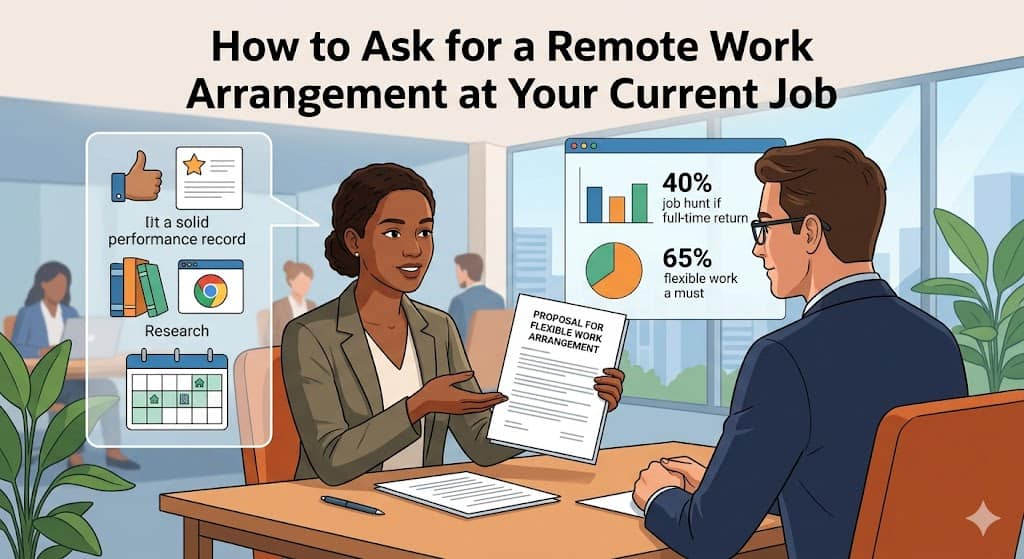
Remote and hybrid work is no longer fringe. It is a mainstream employment expectation, and the data backs that up. According to recent research, 40 percent of employees say they would look for a new job if asked to return to the office five days a week. Nearly two-thirds say location flexibility is now a requirement, not a bonus, when evaluating roles.
- 40% would job hunt if forced back full-time
- 65% say flexibility is a must in new job searches
- 88% of employers now offer some hybrid option
Recent analysis of over 2 million U.S. job postings found that 24 percent of new listings in Q4 2025 were hybrid and 11 percent were fully remote. That is not a shrinking trend. It is a floor. Which means the odds are reasonably good that your employer has already had this conversation with someone else on your team.
You are not asking for something radical. You are asking for something that is now standard in most knowledge-work industries.
What to do before you say a word
Walking into your manager’s office with “I want to work from home” is a request. Walking in with a structured plan is a proposal. The difference in outcome between those two approaches is significant.
Audit your own performance record first
Before your employer evaluates your request, they will evaluate you. Pull your last performance review. Think about recent wins, projects you delivered on time, and any metrics that demonstrate output quality.
Strong performers get approved far more often because the manager can defend the decision internally. If your performance has been inconsistent lately, shore that up before having this conversation.
Understand your company’s existing stance
Check whether colleagues already work remotely, even partially. Look at your employee handbook. If other people on your team are already hybrid, you have a precedent argument. The Muse points out that if remote work is not the standard but the company has shown flexibility in other areas, your chances of negotiating a successful outcome are still strong. The goal is to know the landscape before you walk in.
Know what you actually want before you ask
Fully remote? Two days a week? A trial of one month? Vagueness is a killer in these conversations. Your manager needs to know exactly what you are proposing so they can run it up the chain if needed. Decide on your ideal arrangement and also your minimum acceptable arrangement before the meeting.
Should I ask for full remote or start with hybrid?
Starting with a hybrid proposal increases your approval odds significantly. It signals that you are reasonable, not demanding, and gives your employer an easy yes. Once you have demonstrated reliable output over three to six months, you can revisit a fully remote arrangement from a position of proven trust.
How to build a proposal your manager can approve
The single most common reason remote work requests get denied is that they put the burden of justification on the manager. A well-built proposal removes that burden entirely. Your manager should be able to read your proposal and immediately see how to explain it to their manager.
- A clear statement of the arrangement you are requesting (days, schedule, start date)
- A brief productivity history showing your output is independent of location
- A communication plan: how you will stay reachable and keep your team in the loop
- Tools and setup: do you already have a functional home workspace?
- A proposed check-in cadence so your manager feels continuity, not distance
- A trial period offer, typically 30 to 90 days, with a review meeting baked in
Remote.com advises that you address objections before they are raised. Think about what your manager will worry about, whether that is client availability, team collaboration, or whether you will actually be productive, and include solutions to each concern directly in the proposal document.
$42the average daily saving for employees who work from home instead of the office. This is a useful number to include if you want to frame the request as a lifestyle improvement, not laziness.
When is the right time to bring it up?
Timing is not everything, but bad timing can kill an otherwise strong request. Avoid asking during periods of organizational stress, right after a company miss, during crunch periods on your team, or in the weeks after your manager has had a difficult performance conversation with someone else. You want your manager to be in a reflective, forward-thinking mode, not a defensive one.
Ideal timing windows
After a successful project delivery is one of the best moments. You have fresh evidence of your value, your manager is likely in a positive frame of mind about you, and the conversation can naturally build from “you just did great work” to “here is how I want to keep doing great work.” Annual review cycles are another strategic window, especially if you are discussing your goals and professional development.
Is it better to ask in person or over email?
Start in person or over video to show you take the conversation seriously, then follow up immediately with a written proposal. The written version creates a paper trail, gives your manager something to share with HR, and signals that you are treating this as a professional request, not a casual favor.
How to have the actual conversation
The worst thing you can do in this meeting is lead with how working from home benefits you. Your manager does not need to help you commute less or spend more time with your family. They need to be confident that the work will still get done and that the team will still function. Lead with the business case. Your personal benefits are secondary.
- Open by referencing a recent achievement or positive milestone to set the tone.
- State your request clearly and specifically, including the arrangement you are proposing.
- Explain how productivity, communication, and team cohesion will be maintained or improved.
- Present the proposal document and walk through the key points briefly.
- Offer the trial period proactively. Do not wait for them to suggest it.
- Ask for a specific timeline on when you can expect a decision.
Indeed’s negotiation guide emphasizes going into the conversation with counterpoints already prepared. If your manager raises concerns, you want to have practical solutions ready, not scramble for answers in the room.
Do not give an ultimatumFraming your request as “give me remote work or I’m leaving” may get you an immediate yes, but it signals to your employer that you are already halfway out the door. It also puts you in a weak position if they call your bluff. Reserve ultimatums for when you have already received an outside offer and are genuinely willing to leave.
Sample email to request remote work
If you prefer to open the conversation in writing, the email below gives you a starting structure. Customize the specifics to match your role and your company’s culture. Keep the tone professional but warm.
To: [Manager Name]
Subject: Request to Discuss a Flexible Work Arrangement
Hi [Name], I hope this finds you well. I wanted to reach out about a conversation I’d like to have regarding a potential remote or hybrid work arrangement. Over the past [X months/years], I’ve been focused on [brief mention of key contributions or recent project]. I believe I’ve built a strong record of delivering results, and I’ve been thinking about how I can continue to do that in a way that also increases my effectiveness.
I’ve put together a short proposal that outlines what I have in mind, including my plan for staying accessible to the team, maintaining our current communication rhythms, and a suggested 60-day trial period so we can both assess how the arrangement is working. Would you have 20 minutes this week to walk through it? I’m happy to work around your schedule. Thank you for considering it. [Your Name]
How to handle common objections
“How will I know you’re actually working?”
This objection is really about trust and visibility. The best response is to offer concrete output-based metrics, weekly summary updates, shared project dashboards, or daily standups. Make it easy for your manager to see your work without micromanaging you. Suggest a two-week check-in to review whether the visibility tools are working for both of you.
“We need you available for in-person meetings.”
Offer to come in on specific days or for specific meeting types. A hybrid arrangement where you are present for team days and remote the rest of the week addresses this directly. Most managers are not opposed to remote work as a concept. They are opposed to unpredictability. Give them a predictable schedule.
“The rest of the team has to be in the office.”
This is a fairness concern. Address it directly: acknowledge the consideration, then explain why your specific role, responsibilities, or performance history supports the arrangement. You are not asking on behalf of the whole team. You are asking based on your individual circumstances. If it goes well, others can make their own case.
What if my manager says they’ll think about it and never follows up?
Wait one week, then send a polite follow-up email referencing your original conversation and asking if they have had a chance to review your proposal. Keep it brief and professional. If there is no response after a second follow-up, request a meeting directly. Silence is not a no, but it usually means the request needs someone to push it forward.
What if your company just announced a return-to-office?
This is increasingly common. Data from 2025 shows that 53 percent of companies now require employees to be in office at least three days a week, up from 37 percent the year before. Major employers including Amazon, Dell, and PricewaterhouseCoopers have made headlines with strict return-to-office mandates.
If your company is in this category, you are not out of options. Your approach shifts from “let me try remote work” to “let me demonstrate why my role is an exception.” Lead with past performance during remote periods, emphasize client or output results that were achieved off-site, and propose a structured hybrid arrangement rather than full remote. Companies implementing blanket mandates often still make individual exceptions for high performers or roles that are genuinely location-agnostic.
Can I negotiate remote work during a company-wide return-to-office mandate?
Yes. Mandates are usually policies, not contracts. Individual arrangements are negotiated at the manager and HR level. Come with documented performance evidence, a clear business case, and a willingness to compromise on a hybrid model. Your leverage increases with your seniority and how difficult you would be to replace.
Negotiating a trial period
A trial period is arguably the most powerful tool in this negotiation. It lowers the perceived risk for your employer from a permanent commitment to a temporary experiment. Most managers find it much easier to say yes to “let’s try this for 60 days” than to “I want to go remote permanently.”
Set a specific end date for the trial and agree in advance on what success looks like. That might be project delivery timelines, response time benchmarks, or client satisfaction scores. When the trial ends, you will have data rather than opinion to support making the arrangement permanent. Remote.com recommends proposing a three-month trial explicitly in your initial request to show you have thought through the transition.
What to do if the answer is no
A no is not always final. Ask specifically what would need to change for the answer to become yes. Is it a performance threshold? A role change? Company policy that is currently under review? Getting a clear reason gives you a roadmap. Some employees have successfully revisited the conversation three to six months later after addressing the concerns raised in the initial refusal.
If the no is firm and the company’s direction is clearly toward permanent in-office work, you now have important information about whether this role still fits your life.
Recent Pew data found that 46 percent of workers in remote-capable roles say they would be unlikely to stay if their employer eliminated flexible work. Knowing where you stand helps you make a clear-eyed decision about your next steps.
Is it worth leaving a job just for remote work?
That depends entirely on your financial situation, the strength of the job market in your field, and how much the commute or in-office requirement is actually affecting your quality of life. What the data does show is that you are not alone in weighing this. Remote work has become a serious retention factor, and most employers know it.
The bottom line: a successful remote work request is 20 percent the ask and 80 percent the preparation. Know your performance record. Build a real proposal. Lead with the business case. Offer a trial. And accept that some employers simply are not there yet, which is useful information too.
Free newsletter
Get the Work Insiders weekly
One email a week: the recruiting and HR tech news that mattered, the tools we just added to the directory, and one practical guide. No spam, and you can unsubscribe in one click.