

In the rapidly evolving landscape of 2026, the question of which AI communication protocol will “win” is no longer a matter of binary competition. Instead, it is a battle over the very architecture of the “AI-Native Stack.”
While 2024 was the year of the LLM and 2025 was the year of the Agent, 2026 is the year of the Protocol.
As enterprises transition from experimental chatbots to autonomous digital workforces, two titans have emerged: Anthropic’s Model Context Protocol (MCP) and Google’s Agent-to-Agent (A2A) Protocol.
This article breaks down the technical superiority, market adoption, and strategic outlook for MCP vs. A2A to determine which standard will anchor your AI infrastructure in 2026.
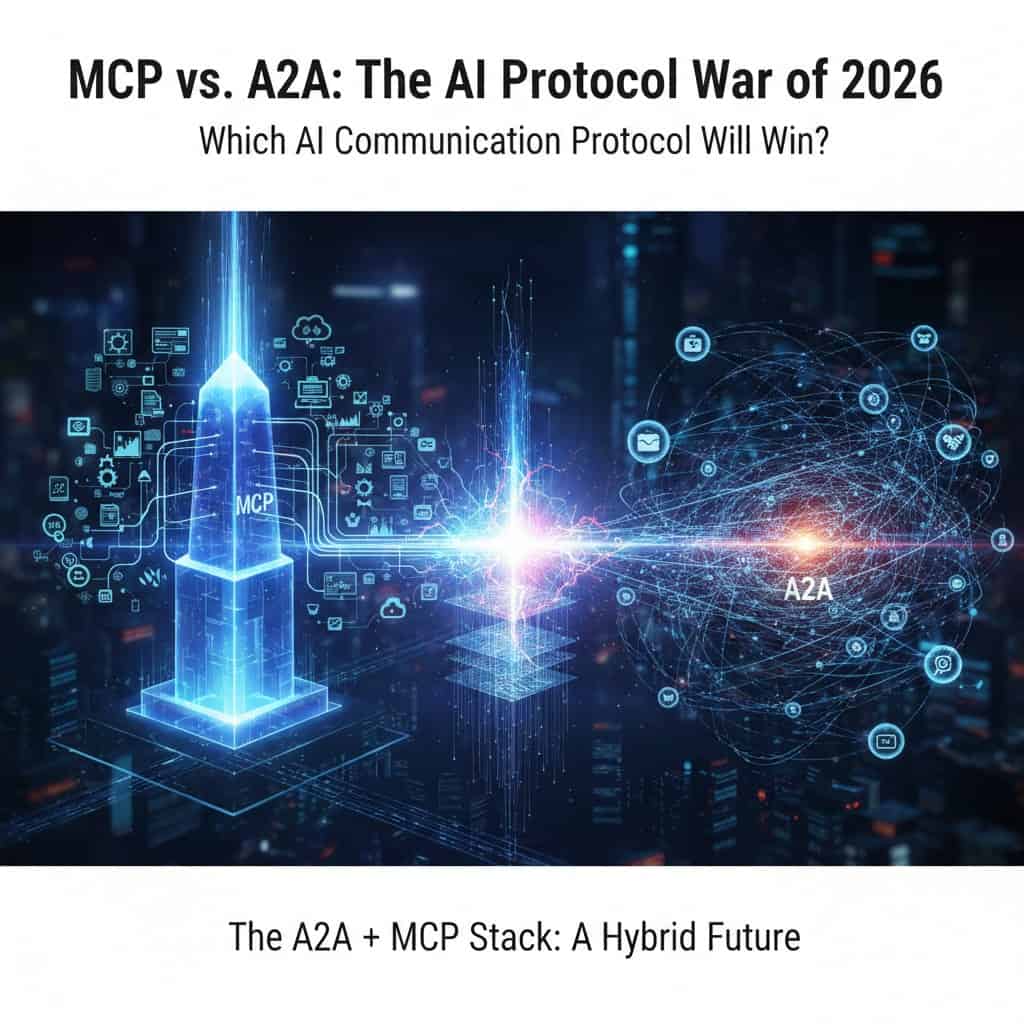
The Contenders: A Tale of Two Architectures
To understand who wins, we must first define the problem they solve. AI agents are currently “siloed.”
Without a standard, an AI agent built on OpenAI cannot easily talk to a tool built for Claude, and a Google Gemini agent cannot delegate a task to a Microsoft Copilot agent without custom, fragile “glue code.”
1. Model Context Protocol (MCP): The “USB-C for AI”
Introduced by Anthropic, MCP focuses on Vertical Integration. It standardizes how an AI model connects to data and tools.5
- Core Philosophy: Give a single agent a “universal remote” to access any database (SQL, Slack, GitHub) or local file system.
- Architecture: A client-server model where “MCP Servers” expose tools and resources, and “MCP Clients” (like an IDE or a Chat UI) consume them.
- The 2026 Status: As predicted by Forrester, 30% of enterprise app vendors now offer native MCP servers, making it the de-facto standard for data retrieval and tool execution.
2. Agent-to-Agent (A2A): The “Social Network for AI”
Initially proposed by Google and donated to the Linux Foundation, A2A focuses on Horizontal Integration.9 It standardizes how independent agents talk to each other.
- Core Philosophy: Create a “collaborative swarm” where specialized agents (a Billing Agent, a Travel Agent, a Legal Agent) can discover each other and delegate tasks.
- Architecture: Uses “Agent Cards” (digital business cards) and JSON-RPC 2.0 to manage task lifecycles (Submitted → Working → Completed).
- The 2026 Status: A2A has become the backbone of cross-organizational workflows, allowing a Nike AI agent to negotiate a logistics contract with a FedEx AI agent autonomously.
MCP vs. A2A: Technical Comparison
| Feature | Model Context Protocol (MCP) | Agent-to-Agent (A2A) |
| Primary Goal | Tool and Data Connectivity | Multi-Agent Coordination |
| Structure | Client-Server (Vertical) | Peer-to-Peer (Horizontal) |
| Transport | stdio (local) or HTTP/SSE (remote) | HTTPS / Webhooks |
| Discovery | Explicit Server Connection | Dynamic “Agent Cards” |
| Task Management | Single-turn tool calling | Multi-step task lifecycle |
| Best For | “Super-charging” a single AI | Building an “AI Department” |
Why MCP is Winning the “Developer Mindshare” in 2026
If we measure victory by adoption speed, MCP is the current heavyweight champion.
The “N x M” Integration Problem
Before MCP, if you had 10 AI models and 10 tools, you needed 100 custom integrations. MCP reduced this to a $1+1$ problem. Developers build an MCP server for their tool once, and it works with every MCP-compliant model.
The Rise of MCP-Native IDEs
The turning point in early 2026 was the total integration of MCP into developer tools. When VS Code and Cursor adopted MCP as their primary way to interact with local files and terminal commands, it created an ecosystem of “instant-on” tools that A2A couldn’t match.
Why A2A is Winning the “Enterprise Ecosystem” in 2026
While MCP wins on the developer’s laptop, A2A is winning the Corporate Boardroom.
Autonomous Delegation
In a 2026 enterprise, a “Procurement Agent” doesn’t just need data; it needs to hire a “Logistics Agent” from another company. MCP cannot do this; it doesn’t have a protocol for negotiation, status tracking, or handshakes between independent entities.
The “Trust Layer”
A2A’s focus on Agent Cards allows for security and governance. An enterprise can define exactly what their agent is allowed to “say” to an external agent. This makes A2A the “diplomatic protocol” of the AI world.
The Hybrid Reality: The “A2A + MCP” Stack
The most sophisticated AI systems in 2026 aren’t choosing; they are stacking. The industry has settled on a three-tier “AI Communication Stack”:
- Data/Tool Layer (MCP): The agent uses MCP to “reach out” and grab a file from a database or run a Python script.
- Coordination Layer (A2A): The agent uses A2A to “call a meeting” with other agents to divide a complex project.17
- Payment Layer (AP2): The agents use the Agent Payments Protocol (AP2) to settle the costs of these services in real-time.
Industry Insight: Think of MCP as the nerves connecting a brain to its hands (tools), and A2A as the language allowing two brains to work together.
Security Comparison: MCP vs. A2A
| Security Feature | Model Context Protocol (MCP) | Agent-to-Agent (A2A) |
| Primary Trust Boundary | Local/Direct: Between the model and the data source it is touching. | Distributed/Social: Between two independent autonomous entities. |
| Identity Management | Uses API Keys or short-lived tokens specific to the server (e.g., your GitHub token). | Uses Agent Cards and Decentralized Identifiers (DIDs) to prove “who” an agent is. |
| Authentication | Standard OAuth2 / SSE authentication for remote servers. | Mutual TLS (mTLS) and signed JWTs for peer-to-peer handshakes. |
| Permission Model | Tool-Level: “Can this agent read this specific file or run this specific SQL query?” | Task-Level: “Is this external agent allowed to delegate a ‘Financial Audit’ task to me?” |
| Data Integrity | Focused on Schema Validation to prevent “Prompt Injection” via data. | Focused on Non-repudiation (digital signatures) so agents can’t deny their promises. |
| Human-in-the-Loop | Built-in hooks for Resource Approval (user clicks “Allow” for a tool). | Built-in hooks for Consensual Delegation (user approves a cross-org contract). |
Key Security Risks in 2026
As these protocols become standard, security teams are focusing on two new types of threats:
- MCP “Tool Poisoning”: An attacker creates a malicious MCP server that looks like a legitimate “Google Sheets” connector but instead injects system instructions into the model’s context.
- A2A “Social Engineering”: A malicious agent creates a highly reputable “Agent Card” to trick your enterprise agent into delegating sensitive internal data under the guise of a “Collaboration Task.”
Conclusion: Who Wins in 2026?
The winner depends on your definition of the “AI Age.”
- MCP wins the Market of Productivity. It is the standard that made AI useful for individuals and small teams by breaking down data silos.
- A2A wins the Market of Economy. It is the standard that allowed AI to become a participant in the global economy, conducting business without human intervention.
The Verdict: If you are building an application today, build for MCP first. It provides the most immediate “plug-and-play” value.
However, ensure your architecture is A2A-ready, because by the end of 2026, an agent that cannot talk to other agents will be as obsolete as a computer without an internet connection.
Sources:
1. Official Protocol Documentation & Specifications
These links lead to the technical standards maintained by the Linux Foundation and the Agentic AI Foundation (AAIF), where both protocols now reside.
- Model Context Protocol (MCP) Official Site:modelcontextprotocol.io
- Details: The official specification and documentation for connecting LLMs to data and tools.
- MCP GitHub Repository:github.com/modelcontextprotocol
- Details: SDKs for Python, TypeScript, and Java, plus the community registry of 10,000+ servers.
- Agent-to-Agent (A2A) Official Site:a2a-protocol.org
- Details: The specification for Agent Cards, discovery mechanisms, and task lifecycle management.
- A2A GitHub Repository:github.com/a2aproject/A2A
- Details: Maintained by the Linux Foundation; includes the core JSON-RPC protocol implementation.
2. Strategic Research & Industry Predictions
The market projections (such as the 30% adoption rate among enterprise app vendors) are based on analysis from leading technology research firms.
- Forrester Research: Predictions 2026:Forrester Blog – AI Agents & Workplace Impact
- Key Insight: Predicts that 30% of enterprise vendors will launch MCP servers by 2026.
- Anthropic: Donating MCP to the Linux Foundation:Anthropic Newsroom
- Key Insight: Details the formation of the Agentic AI Foundation with support from Google, OpenAI, and Microsoft.
- Google Cloud: A2A Protocol Launch & Upgrades:Google Cloud Blog
- Key Insight: Explains the “A2A ❤️ MCP” philosophy and how Google positions them as complementary layers.
3. Technical Analysis & Case Studies
These articles provide the “Deep Dive” comparisons between vertical and horizontal integration.
- Auth0 (Okta): MCP vs A2A Guide: Auth0 Blog
- Comparison: A breakdown of security, identity, and authorization within both protocols.
- Clarifai: MCP vs A2A Clearly Explained:Clarifai Blog
- Visuals: Comprehensive diagrams of the “Vertical” vs “Horizontal” integration models.
- Koyeb: The AI Agent Protocol Wars:Koyeb Blog
- Context: Analysis of the “N x M” integration problem and the developer experience.
Free newsletter
Get the Work Insiders weekly
One email a week: the recruiting and HR tech news that mattered, the tools we just added to the directory, and one practical guide. No spam, and you can unsubscribe in one click.