

Navigating the job search process can feel like an endless maze of applications, interviews, and waiting. If you’re wondering how many interviews you’ll need to attend before landing that coveted job offer, you’re not alone.
The modern hiring process has evolved significantly, with candidates often going through multiple rounds before receiving an offer or even knowing where they stand.
This comprehensive guide breaks down everything you need to know about interview expectations, from the average number of rounds to success rates at each stage, and answers the most common questions job seekers have about the interview process.
The Reality: How Many Interviews Does It Take?
Interviews Per Single Position
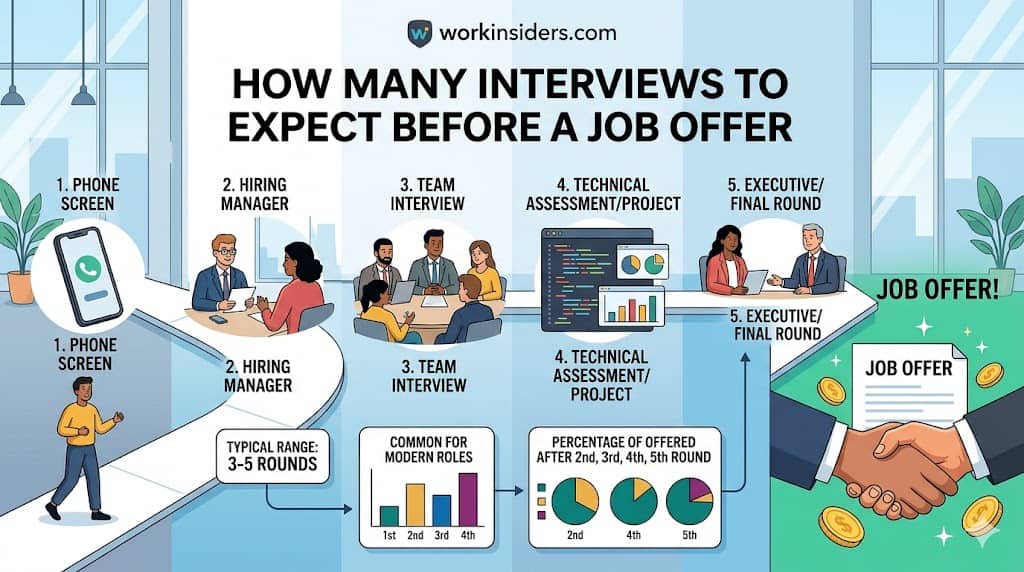
When applying for a specific position, candidates typically go through two to five rounds of interviews before receiving a job offer, with the exact number varying by industry, position level, and company hiring practices.
More than half of recruiters and hiring managers agree that three interviews is the average number before extending an offer, while 22% say four interviews is typical, and 9% report that five or more rounds may be necessary.
Here’s what you can expect based on position level:
Entry-Level Positions: One or maximum two interviews are usually sufficient for lower-level positions, as these roles often prioritize soft skills and potential over extensive experience.
Mid-Level Positions: Two to three interviews seem adequate for mid-level roles, allowing employers to assess both technical capabilities and cultural fit.
Senior-Level Positions: Companies might conduct up to five rounds of interviews for senior positions, as they seek candidates who are not only skilled but also responsible and trustworthy enough to lead teams and make strategic decisions.
Total Interviews Across Your Job Search
The picture changes dramatically when we look at your entire job search journey rather than just one position.
The average number of interviews before getting a job offer across all applications is anywhere between 10 and 20, with every application having an 8.3% chance of proceeding to the interviewing stage.
A 2025 survey of 1,000 UK job seekers who recently secured positions found that it takes an average of 5 interviews total to land a job, including all interviews attended for every company during their most recent job search.
The data reveals an important reality: A 2025 Career.IO study found that the average job seeker applies to 32 jobs and gets 4 interviews before being hired, though other research shows job seekers typically need 100-200+ applications to secure a single offer.
Understanding Your Odds: Interview Success Rates
From Application to First Interview
The competition is fierce from the very start. The average corporate job attracts 250 applicants, but only four to six of those individuals get called in for an interview. This means only 2-3% of applicants will receive an interview on average.
Progression Through Interview Rounds
Once you’ve secured that initial interview, your odds improve significantly at each stage:
First Interview: Candidates who did one job interview had a 36.89 percent chance of receiving a job offer, while those who had three job interviews had a 51 percent chance of receiving an offer.
Second Interview: There is a 25-50% chance of getting the job after the second interview, though for larger companies and higher-level positions, you may have additional rounds before the offer stage.
After the initial shortlist, between three and six candidates are chosen for a second in-person interview, representing just 2% to 5% of the total applicant pool. If you’ve made it to the second interview, your chances have increased substantially.
Third Interview: If you’ve made it past the first and second interview and managed to land a third one, it usually means you’re the primary candidate for the job and your potential employer is interested in discussing the position in more detail.
Final Interview: Usually, 2-3 candidates are invited to the final round of interviews, representing only the most qualified candidates from an often large applicant pool.
Overall Success Rate
The success rate of job interviews is 20%, meaning that only 1 in 5 candidates are offered a job after completing the interview process. Additionally, a study by LinkedIn reveals that only 2% of applicants are selected for a second interview, and subsequently, only one in six candidates receives a job offer.
Timeline: How Long Does the Interview Process Take?
Average Duration from Application to Offer
According to recent data from Glassdoor, the average interview process in the United States takes about 23.8 days, though the typical timeframe in 2024 is 24 days.
The Society of Human Resource Management says 42 days is a reasonable timeframe to expect a resolution, while other studies report an average of 27 working days.
The average length of time it takes a job seeker to land a job in the UK is 3.8 months (about 114 days) from updating your CV to receiving a job offer.
Time Between Interview Stages
If you make it through the initial screening process, you can usually expect to hear back about an in-person interview about a week later. The breakdown typically looks like this:
- Application to phone screen: 5 days
- Phone screen to in-person interview: 7 days
- In-person interview to competency assessment: 7 days
- Competency assessment to second interview: 5 days
- Second interview to background check: 3-5 days
- Background check to job offer: 7 days
If the employer decides to go through each of these stages, you may receive an official job offer after about eight weeks.
Industry Variations in Timeline
Government jobs take almost twice the average U.S. length to fill at 53.8 days total, followed by Aerospace & Defense at 32.6 days and Energy & Utilities at 28.8 days.
On the opposite end, the Restaurants & Bar industry has speedy interview processes at just 10.2 days, along with Private Security at 11.6 days and Supermarkets at 12.3 days.
By position: Highly skilled professionals like professors face 60.3-day processes, business systems analysts 44.8 days, and research scientists 44.6 days, while waiters average just 8 days, retail representatives 8.5 days, and delivery drivers 8.5 days.
Common Types of Interviews You’ll Encounter
Understanding the different interview formats helps you prepare more effectively for each stage.
Phone Screening Interview
This screening interview is conducted over the phone to assess basic qualifications and suitability for the role before inviting the candidate for an in-person interview, with the average phone interview lasting approximately 15 minutessignificantly shorter than in-person interviews, which typically last 45-90 minutes.
Video Interview
60% of hiring managers use or have used video interviewing in the hiring process. As a percentage of total interviews recorded in recent surveys, 6% were carried out via telephone, 28% by video call, and 66% via face-to-face meeting, showing that while video interviews have increased in popularity, employers still value in-person meetings.
Panel Interview
In a panel interview, the candidate is interviewed by multiple interviewers simultaneously, often representing different departments or levels within the organization. This format allows various stakeholders to assess candidates and gather diverse perspectives.
Behavioral Interview
Behavioral interviews predict how your past behavior may affect your performance at a new job, with interviewers asking you to tell stories or give examples of how you’ve overcome challenges, successfully solved problems, or resolved situations with coworkers.
Final Interview
Final interviews are the last interviews you complete before a job offer and may combine with another interview type depending on how the company structures their hiring process, often involving upper-level management or the company CEO.
Why Do Companies Hold Multiple Interview Rounds?
The trend toward more interviews has accelerated in recent years, leaving many candidates frustrated. Here’s why companies maintain multi-round processes:
Thorough Candidate Assessment
Companies assess potential candidates for different skills and evaluate their capabilities by conducting multiple interviews, with different rounds testing technical expertise, cultural fit, problem-solving abilities, and leadership potential.
Multiple Stakeholder Input
Interviewers conduct multiple interviews because they have multiple stakeholders to please and a lot of competition to narrow down. Different team members, departments, and levels of leadership often need to meet candidates before a hiring decision is made.
Remote Work Impact
Career coach Steven Leitch notes that with the rise of remote work and a larger pool of talent accessible to companies, they are increasingly cautious and seeking more ways to assess candidates thoroughly.
Risk Mitigation
Hiring managers think holding multiple interviews shows they’re being thorough in the hiring process and that they’re trying to make an informed decision for everyone involved. Bad hires are expensive—they want to get it right the first time.
Frequently Asked Questions About the Interview Process
How long should I wait to follow up after an interview?
Wait about a week after submitting your application, then send a polite email to the recruiter or hiring manager. After an interview, send a thank-you note within 24 hours, then wait for the timeline they provided. If they didn’t give you one, waiting about a week before following up is appropriate.
What does it mean if my interview was shorter than expected?
Do not panic if the interview is shorter than expected observing the interviewers’ body language, tone, and facial expressions could be a better way to gauge your performance at the interview. Sometimes shorter interviews simply mean the interviewer got the information they needed efficiently.
How many interviews is too many?
If you’re conducting more than three rounds of interviews, you could be losing candidates to companies with faster processes. While senior positions may justify 4-5 rounds, anything beyond that often signals organizational indecision or inefficiency.
What if I don’t hear back after my interview?
There might be various reasons you haven’t heard back after your most recent interview, including: other candidates are still interviewing, hiring managers are collecting interviewer feedback, or the hiring manager has to make a decision among multiple qualified candidates.
If an employer hasn’t updated your application status within the specified timeline, you may contact them to ask if they have made a decision, remaining polite and professional while reiterating your interest in the role.
Does getting a second interview mean I’m getting the job?
Not necessarily, though it’s a very positive sign. Second interviews indicate strong interest from employers but do not guarantee a job offer, with probability varying based on company size, role level, industry competitiveness, and your performance.
Getting a second interview means you have successfully impressed the interviewers in the first round and the employers would like to get to know you on a deeper level. However, you’re still competing against other qualified candidates at this stage.
What percentage of candidates get hired after a final interview?
Approximately 42 in 100 interviewed candidates receive an offer, and nearly 66 in 100 candidates who receive an offer accept it, meaning the average onsite interview success rate is almost 66%.
How many applications should I submit to get interviews?
A recent survey reveals that it takes 100-200 applications on average to get one job offer, which translates to 10-20 applications to land an interview and about 10-15 interviews to get an offer.
However, quality matters more than quantity. According to Gem’s data, a sourced (outbound) candidate is 5× more likely to be hired than someone who just applies online, emphasizing the value of networking and referrals.
Strategies to Improve Your Interview Success Rate
Target Your Applications Strategically
Rather than applying to hundreds of positions, focus on roles that genuinely match your qualifications and career goals. One of the most crucial steps in your job search is identifying roles that align with your skills, experience, and career aspirations, as applying for every job you come across can be tempting but a scattergun approach often leads to frustration and wasted effort.
Leverage Networking and Referrals
One referral is worth 40+ cold applications spend less time hitting “submit” and more time building relationships. Referred candidates not only have higher interview rates but also higher success rates once they reach the interview stage.
Prepare Thoroughly for Each Interview
According to Niki Woodall, a former recruiter at Meta, applicants should “Focus on mock interviews. That’s the number one thing, since you have control over how much you prepare”.
About 33% of recruiters claim they decide whether they will hire a candidate in the first minute and a half of the interview, so the first 90 seconds play a significant role. This makes thorough preparation and a strong first impression absolutely critical.
Master Common Interview Questions
The most common job interview question is “Tell me about yourself,” with 93% of hiring managers asking this question. Prepare compelling stories that demonstrate your qualifications, problem-solving abilities, and cultural fit.
Follow Up Professionally
86% of hiring managers say that a thank-you email or note after an interview has some influence on their decision-making process. A thoughtful follow-up can set you apart from other candidates and keep you top of mind.
Understand Body Language and Presentation
67% of employers believe that failure to make eye contact is a common nonverbal mistake made by candidates during job interviews. Your nonverbal communication matters as much as what you say.
Use Your Recruiter as a Resource
If you took the time to establish a connection with a recruiter during the interview process, build that relationship and ask questions like: How far along in the interview process is the hiring manager? What should I know about the hiring team that may not be in the job posting?
Industry-Specific Interview Expectations
Different industries have vastly different hiring timelines and interview structures. Here’s what to expect:
Technology Sector
The tech industry has a comprehensive hiring process but can sometimes be faster due to the competitive nature of the market, with junior programmers averaging 30-day processes while experienced engineers average 47 days.
Restaurant and Retail
Restaurant and Food Service has the best interview-to-hire rate at 17%, followed by Retail at 12%, Healthcare at 12%, and Hospitality, Entertainment & Recreation at 11%. Interview statistics show that restaurants and bars have by far the shortest interview process, taking only 10 days to make additions to their staff.
Government and Public Sector
According to data from Glassdoor, leadership roles usually have a minimum of 3 interview stages and will always include at least one face-to-face interview, while entry-level positions usually require only 1 interview stage and Public Sector roles can require as many as 6 interview stages.
Professional Services
In professional services such as law, finance, engineering, or consulting, the hiring process can be lengthy and meticulous, with companies looking for candidates with industry-specific qualifications and experience from a smaller talent pool, taking between 25 to 47 working days on average.
Red Flags in the Interview Process
While multiple rounds are normal, certain signs suggest a problematic hiring process:
Excessive Delays and Poor Communication
Long gaps between interview rounds or feedback often result in disengagement, with candidates potentially interpreting the silence as disinterest or simply losing interest themselves.
Too Many Interview Rounds
Candidates sharing their experiences reported undergoing seven to nine-plus rounds of interviews, which shows the competitive job market but can also indicate organizational indecision or unclear hiring criteria.
Lack of Clear Timeline
A process that drags on without updates can signal disorganization or lack of interest, negatively shaping the candidate experience and the employer brand.
The Bottom Line: Setting Realistic Expectations
Understanding interview statistics helps you approach your job search with realistic expectations and a strategic mindset. Here are the key takeaways:
For a Single Position: Expect 2-5 interview rounds depending on the seniority level, with 3 being the most common across industries.
Across Your Job Search: Plan for 10-20 total interviews before landing an offer, though this varies significantly based on your industry, experience level, and job search strategy.
Timeline: The average process takes 24-42 days from application to offer, though this can range from 10 days in hospitality to 60+ days in government and specialized professional roles.
Success Rates: Only 2-3% of applicants get interviews, but once you reach the second interview, your odds improve to 25-50% of receiving an offer.
Quality Over Quantity: One referral is worth 40+ applications, and networking significantly improves your chances at every stage of the process.
Remember that interviewers want you to succeed and are rooting for you—they wouldn’t waste their time conducting interviews if they weren’t hoping to find the right candidate. Each interview is an opportunity to learn, improve, and get one step closer to your ideal role.
The job search process tests persistence and resilience, but armed with these statistics and strategies, you’re better prepared to navigate the journey from application to offer with confidence and realistic expectations.
Sources
- TeamStage – Job Interview Statistics: Applications and Hiring Rates in 2024
- Fast Company – 7 Lessons About Landing a Job from 30 Recruiters
- Indeed – FAQ: How Many Job Interviews Are in the Hiring Process?
- 4 Corner Resources – How Long Should Your Interview Process Last?
- Broadbean – How Long Does the Hiring Process Take?
- Workable – Hiring Process FAQ: A Guide to Structured Recruitment
- LinkedIn News – How Long Does It Take to Get Hired?
Free newsletter
Get the Work Insiders weekly
One email a week: the recruiting and HR tech news that mattered, the tools we just added to the directory, and one practical guide. No spam, and you can unsubscribe in one click.