

The world of work has changed faster than anyone could have predicted. From North America to Europe, Asia-Pacific, and beyond, companies are balancing office collaboration with remote flexibility. This evolution has given rise to the hybrid work model, a blend of in-office and remote working that is redefining how we work, live, and lead.
In this data-driven guide, we explore 37 powerful hybrid working statistics, covering adoption rates, productivity, employee satisfaction, challenges, and future trends.
Whether you are an HR leader, business owner, or employee, these insights reveal where hybrid work is heading and how it is reshaping workplaces around the world.
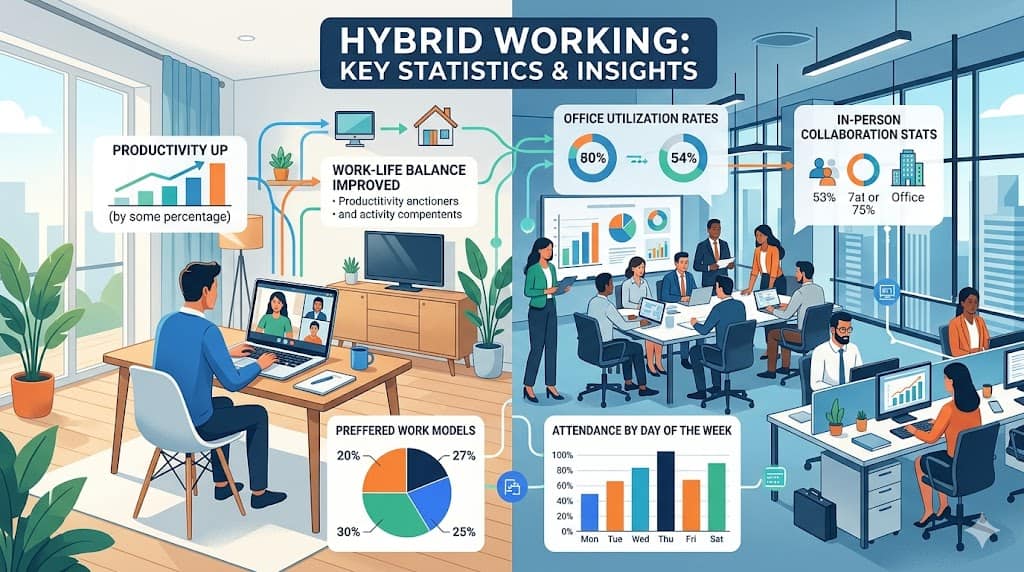
Global Adoption and Prevalence of Hybrid Work
- Around 49% of desk workers worldwide currently work in hybrid arrangements, while 66% would prefer a hybrid setup (Amply News)
- In the United States, 53% of remote-capable employees are working hybrid schedules.
- 60% of North American business leaders say their companies now operate hybrid models
- Hybrid job postings have increased to 24% of all listings in early 2025, up from just 9% in 2023.
- Globally, 45% of remote-capable employees are in hybrid work setups, down from 62% in 2022 (Prodshell )
- 84% of global organizations now offer hybrid work options (Second Talent)
- In higher education, only 28% of employees have hybrid or remote flexibility, yet 61% wish they did (CUPA-HR).
Employee Preferences Around the World
- In the United States, 54% of employees prefer hybrid work over fully remote or on-site setups (What’s The Big Data)
- 40% of hybrid workers have full autonomy in deciding when to go into the office
- The global average for hybrid attendance is 2.6 days in-office per week
- 39% of hybrid or remote employees report higher stress levels due to blurred boundaries between work and home (Owl Labs)
- 68% of working parents globally worry about balancing caregiving duties with hybrid schedules
Productivity and Performance in Hybrid Work
- Studies estimate hybrid workers are 5% more productive than those working fully on-site or fully remote
- 66% of managers say hybrid work improved productivity
- 73% of hybrid employees globally report higher productivity, saving an average of 7.6 hours weekly
- 82% feel connected to managers, and 87% feel connected to their teams
- Employee engagement is stronger under hybrid work, with 36% of hybrid employees feeling engaged compared to 30% of in-office workers
Employee Satisfaction, Work-Life Balance, and Retention for Hybrid Work
- Hybrid employees experience higher job satisfaction and better work-life balance than those fully on-site
- Hybrid work reduces resignations by 33%, improving employee retention
- Offering hybrid work can cut turnover rates by 25%
- 72% of hybrid workers worldwide say their work-life balance improved significantly
- 64% of U.S. employees prefer hybrid or remote roles when considering new job offers (Founder Reports)
- Business Strategy, Cost Savings, and Policy Trends
- 57% of global organizations have reduced office space due to hybrid operations
- The three-day in-office and two-day remote model is the most common hybrid schedule globally (IFEBP)
- 46% of companies now require more in-office days than they did two years ago
- In the United States, 61% of companies have official return-to-office (RTO) policies in place
Challenges and Considerations in Hybrid Models
28. 62% of organizations cite difficulty coordinating hybrid schedules as a key challenge
29. 54% struggle with technology and connectivity issues
30. 48% report maintaining company culture is difficult in a hybrid setup
31. Only 34% of employees fully control their hybrid schedules
32. Hybrid adoption is declining in public sector roles, where presence requirements remain high
Demographic and Regional Insights on Hybrid Work
- Employees with disabilities are 11% more likely to prefer hybrid work
- Non-binary employees are 14% more likely to prefer hybrid setups
- Hybrid work dominates in knowledge-based industries such as technology, marketing, and finance, while it remains rare in manufacturing and healthcare
- In the United States, hybrid job postings are highest in Massachusetts (31%), Minnesota (30%), and New York (29%)
- In higher education, hybrid work has dropped from 24% in 2023 to 16% in 2025
Why These Hybrid Work Statistics Matter Globally
Competitive Advantage in Hiring and Retention
Hybrid work is now a global talent magnet. Companies offering flexibility attract top performers and see lower attrition rates.
Productivity and Performance
Data shows that hybrid models outperform traditional setups when supported by strong leadership and digital tools.
Employee Wellbeing and Balance
Hybrid work supports mental health and family life, especially in regions where long commutes are common.
Office and Real Estate Strategy
Businesses are rethinking office space, favoring smaller, collaborative hubs over traditional offices in cities like London, New York, and Singapore.
Implementation Challenges
Time zones, culture, and digital divides all shape hybrid work success across global markets.
Actionable Takeaways for Employers
- Develop clear hybrid policies balancing flexibility with collaboration.
- Train managers in hybrid leadership and communication.
- Offer schedule flexibility and promote fairness across teams.
- Measure productivity through outcomes, not online hours.
- Reimagine office spaces as collaboration hubs.
- Embrace diversity and inclusion to ensure equal access to hybrid benefits.
- Communicate expectations clearly and consistently.
The Global Outlook for Hybrid Work in 2025 and Beyond
Hybrid work is no longer a trend; it’s a defining feature of modern work. Around the world, employees expect flexibility, autonomy, and balance. By 2030, over 70% of knowledge workers globally will spend part of their time working remotely.
Organizations that continuously refine their hybrid strategies using data and employee feedback will lead the next decade of innovation.
Conclusion
Hybrid work is not just a post-pandemic experiment — it’s the future of work. From higher productivity to improved well-being, the data is clear: hybrid work benefits both employers and employees.
Whether you are designing policies, managing global teams, or rethinking office space, these 37 hybrid working statistics offer essential insights into the future of work.
Free newsletter
Get the Work Insiders weekly
One email a week: the recruiting and HR tech news that mattered, the tools we just added to the directory, and one practical guide. No spam, and you can unsubscribe in one click.