

Generative Engine Optimization (GEO) is the emerging set of tactics and principles that publishers use to make their content discoverable, relevant, and preferred by generative AI systems (the engines behind ChatGPT, Perplexity, Google’s Gemini, Grok, Microsoft Copilot, and similar assistants).
As search behavior shifts from query → results page → click to conversational prompts → single-answer output, GEO asks: how do we show up in the answer, get cited by the model, and still get meaningful referral traffic or conversions?
This article explains GEO in plain language, compares it to classic SEO, explores measurable signals like rankings and model relevance, answers common questions, and includes visual data that show how AI platforms are already driving traffic to websites.
To succeed in both:
- Use SEO for visibility and long-term organic reach.
- Use GEO for immediate inclusion and authority in AI responses.
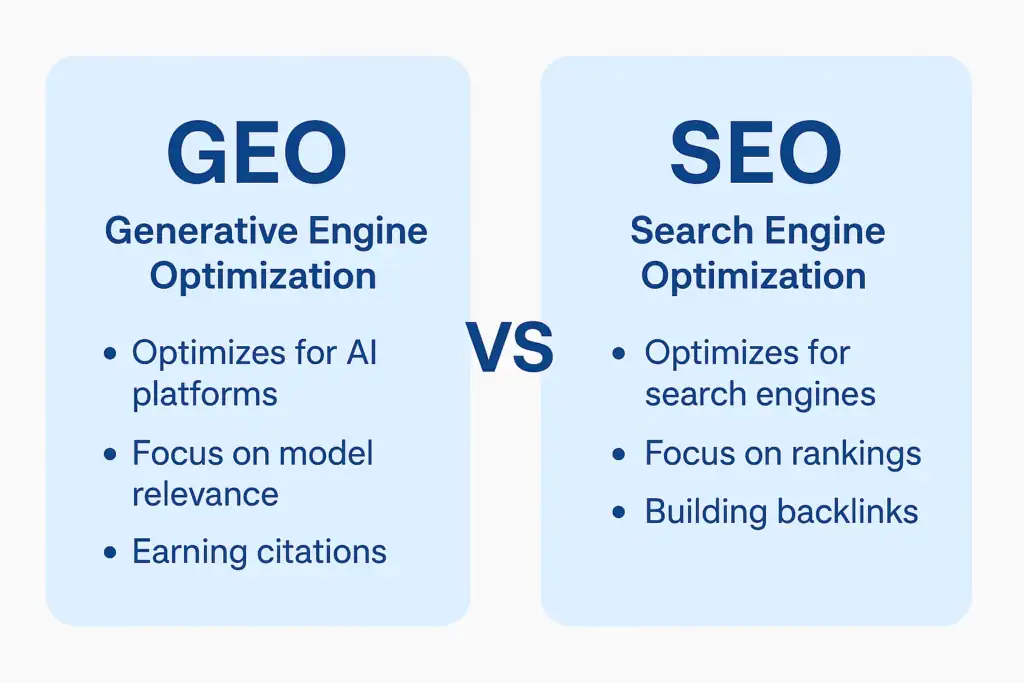
The Core of GEO: What’s Different from SEO
Classic SEO is about optimizing for search engine result pages (SERPs): ranking for queries on Google, dominating organic snippets, improving click-through rates, and earning backlinks. GEO builds on SEO but changes the target:
- Target: Model outputs, not just SERPs. Instead of optimizing for a blue-link position, GEO focuses on inclusion in AI-generated answers, summaries, or chat responses that users see directly in conversational platforms.
- Signals shift from backlink-centric to evidence-centric. Generative engines prefer sources that are accurate, current, and clearly authoritative. Structured data, clear provenance, and trustworthy citations matter more than keyword density.
- Attribution matters. Some AI platforms include source links, while others paraphrase. GEO-friendly pages are written in ways that are easily cited or summarized by models.
- User intent interpretation is different. LLMs handle long-form and follow-up prompts. Content that anticipates conversational follow-ups with structured FAQs, summaries, and deep dives performs best.
Think of GEO as SEO for the answer, not the listing.
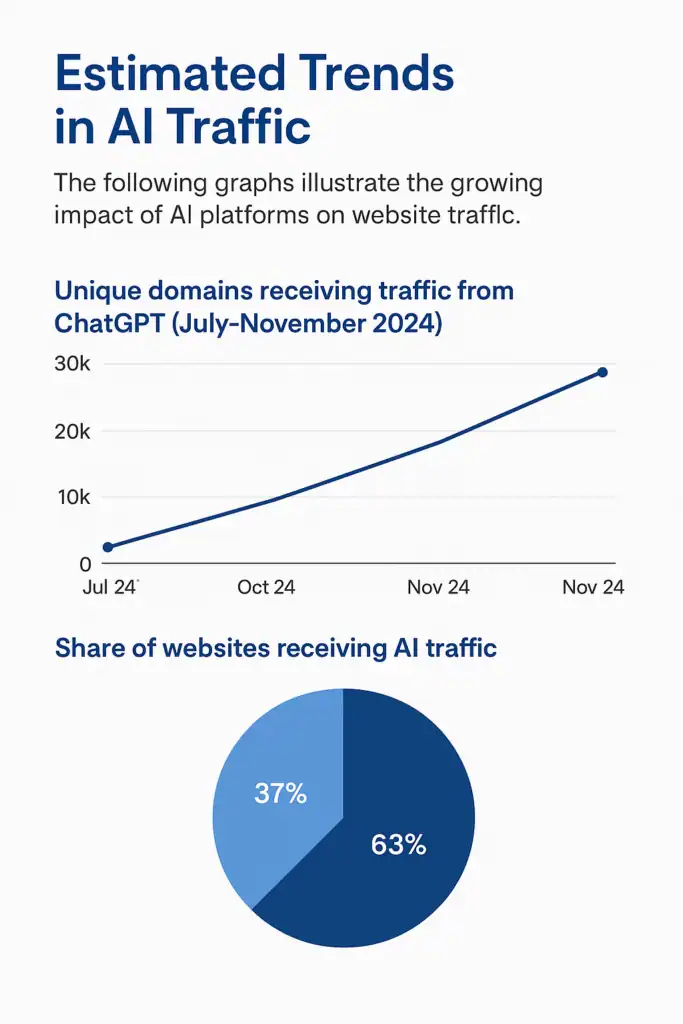
Data Snapshot
- The line chart shows how unique domains receiving ChatGPT traffic grew from about 8,000 in July 2024 to roughly 30,000 by November 2024.
- The pie chart shows that about 63% of sites now receive some AI traffic, based on Ahrefs’ 2024 analysis.
These trends reveal that GEO is no longer theoretical. AI platforms are already reshaping web visibility.
Why GEO Matters Now
Several studies show that AI systems are already sending measurable traffic to websites, and the trend is growing quickly.
- Semrush found ChatGPT sent traffic to fewer than 10,000 unique domains in early July 2024, rising to over 30,000 by November 2024, marking a 300% increase in just a few months.
- Ahrefs’ study of 3,000 websites showed that 63% of them received at least one visit from an AI source, with ChatGPT being the largest AI traffic referrer.
- AI-driven traffic is still smaller than Google’s, but it’s growing fast, especially for educational, tech, and informational sites. CTRs from AI can be lower, but intent quality and engagement are often higher.
GEO vs SEO: Side-by-Side Comparison
| Topic | Classic SEO | GEO (Generative Engine Optimization) |
|---|---|---|
| Primary Target | SERPs and organic rankings | AI-generated outputs, answers, and summaries |
| Key Signals | Backlinks, on-page optimization, keyword relevance | Extractability, citations, structure, freshness, and authority |
| Content Type | Long-form keyword-based pages | Short summaries, structured facts, schema-enhanced layouts |
| Measurement | Impressions, clicks, keyword rankings | Model citations, AI referrals, visibility in AI summaries |
| Link Value | Backlinks determine authority | Links still matter, but structured credibility and transparency are prioritized |
Rankings vs Model Relevance
Rankings measure where your page appears on a SERP. Model relevance measures whether a generative system will select your content as a reliable answer to a prompt.
A page might rank high in Google but still be ignored by AI models if it lacks structured data or clear sourcing. Conversely, a well-structured, fact-based article can appear in AI-generated summaries even without top Google rankings.
To succeed in both:
- Use SEO for visibility and long-term organic reach.
- Use GEO for immediate inclusion and authority in AI responses.
GEO Best Practices Checklist
- Start with structured summaries. Add a TL;DR or key points section at the top of each article.
- Show clear sourcing and freshness. Display the publish date, last update, and cite credible data.
- Use schema markup. Add FAQ, Article, and Dataset schema to improve machine readability.
- Add short, verifiable facts. Include clear numbers and data tables that AI can extract.
- Canonicalize your main source pages. Prevent duplicate content from confusing models.
- Design for follow-up intent. Use headings and anchor links to support conversational queries.
- Track AI referrals. Monitor analytics and referral sources tagged as AI platforms.
- Maintain E-E-A-T. Demonstrate expertise, experience, authority, and trustworthiness.
GEO Metrics to Track
- AI referral sessions from chatbots and AI browsers.
- Appearances in AI summaries or overview panels.
- Number of citations from AI models in public outputs.
- Conversions or engagement from AI-origin visitors.
- Changes in impressions for AI-related keywords.
These metrics are still evolving, but tracking them now provides early insight into AI-driven visibility.
Common Questions About GEO
Q: Is GEO just SEO rebranded?
A: No. GEO uses SEO principles but targets a different system: generative AI. It focuses on how models understand, cite, and reproduce content rather than how algorithms rank it on a results page.
Q: Will GEO replace SEO?
A: Not likely. Google and Bing still drive the majority of web traffic, but GEO complements SEO by expanding reach into AI platforms that now influence how users discover information.
Q: Do backlinks still matter?
A: Yes. Authority remains essential, but GEO also values structured facts, transparent sourcing, and extractable information.
Q: How do I optimize for ChatGPT or Gemini specifically?
A: Focus on clarity, facts, and trust signals. Use schema markup, update content frequently, and keep your site fast and well-structured.
Q: How can I see if I’m being cited by AI?
A: Tools like Semrush, Ahrefs, or manual tests can track model citations or referral URLs from AI platforms.
Rankings and Relevance Framework
- Identify key queries your audience asks conversationally.
- Ensure your content directly answers those questions in under 200 words.
- Add citations, schema, and clear formatting.
- Track changes in AI referrals or mentions over time.
- Repeat for each high-impact topic or pillar page.
Final Thoughts
- GEO and SEO should work together, not separately.
- Focus on clarity, data integrity, and structured formats.
- Track emerging metrics like AI referrals and model citations.
- Experiment, learn, and adapt as generative search continues to evolve.
Generative Engine Optimization is the next frontier of search. Brands that learn how to make their content machine-readable, fact-rich, and trustable will earn visibility not just in rankings but inside the conversations shaping the future of discovery.
Sources & further reading
- Semrush : New Semrush Study Reveals ChatGPT Search Trends (80M+ clickstream analysis). Semrush
- Ahrefs: 63% of Websites Receive AI Traffic (study of 3,000 sites). Ahrefs
- Search Engine Land: ChatGPT growing as a traffic referrer. Search Engine Land
- Arc Intermedia: Impact of AI Search on CTR & User Behavior. Arc Intermedia
- Datos / clickstream analysis: Top domains referred from SearchGPT (Oct 31, 2024 – Jan 16, 2025). Datos
Free newsletter
Get the Work Insiders weekly
One email a week: the recruiting and HR tech news that mattered, the tools we just added to the directory, and one practical guide. No spam, and you can unsubscribe in one click.